Modernizing faceted navigation for care discovery

Evolved an outdated filtering experience into an intuitive faceted search system that improves discoverability, clarity, and trust, enabling members to more confidently find care.

Company:

Zelis

Role:

Senior product designer

Date:

2024-2025

Team:

Design · UXR · Engineering · Product

Finding the right doctor can be a struggle…

Finding the right doctor can be a struggle…

Finding the right doctor can be a struggle…

Imagine logging into your health insurance portal to find a nearby female psychiatrist who accepts new patients, only to be entangled in an outdated, clunky navigation system. 

Imagine logging into your health insurance portal to find a nearby female psychiatrist who accepts new patients, only to be entangled in an outdated, clunky navigation system. 

Imagine logging into your health insurance portal to find a nearby female psychiatrist who accepts new patients, only to be entangled in an outdated, clunky navigation system. 

While finding the right healthcare provider should be an accessible task, it is an all-too-common challenge in the healthcare space, one to which our white-label provider directory was not immune, affecting 87 million users across 32 health plans. 

While finding the right healthcare provider should be an accessible task, it is an all-too-common challenge in the healthcare space, one to which our white-label provider directory was not immune, affecting 87 million users across 32 health plans. 

While finding the right healthcare provider should be an accessible task, it is an all-too-common challenge in the healthcare space, one to which our white-label provider directory was not immune, affecting 87 million users across 32 health plans. 

Despite handling over 600 million searches annually, the faceted navigation had not been updated in six years. Regulatory priorities, sales, and client demands overshadowed critical UX/UI improvements.

Despite handling over 600 million searches annually, the faceted navigation had not been updated in six years. Regulatory priorities, sales, and client demands overshadowed critical UX/UI improvements.

Despite handling over 600 million searches annually, the faceted navigation had not been updated in six years. Regulatory priorities, sales, and client demands overshadowed critical UX/UI improvements.

The result? Frustrated users and a system unable to meet evolving users' needs and growing business demands. 

The result? Frustrated users and a system unable to meet evolving users' needs and growing business demands. 

The result? Frustrated users and a system unable to meet evolving users' needs and growing business demands. 

Where we started

Guided by our north star vision and best in class search practices

Recognizing the opportunity to improve a critical but underperforming part of the experience, we grounded the work in a North Star vision. This vision was informed by comprehensive industry research and by best-in-class search

Recognizing the opportunity to improve a critical but underperforming part of the experience, we grounded the work in a North Star vision. This vision was informed by comprehensive industry research and best-in-class search practices from experts like

experts such as

Peter Morville

Peter Morville

Peter Morville

and

Greg Nudelman.

Greg Nudelman.

Greg Nudelman.

It enabled us to:

Socialize the issues with faceted navigation and advocate for a redesign at a broader scale 

Discuss feasibility and foster alignment with our technical partners 

Apply CX continuous improvement practices to our team 

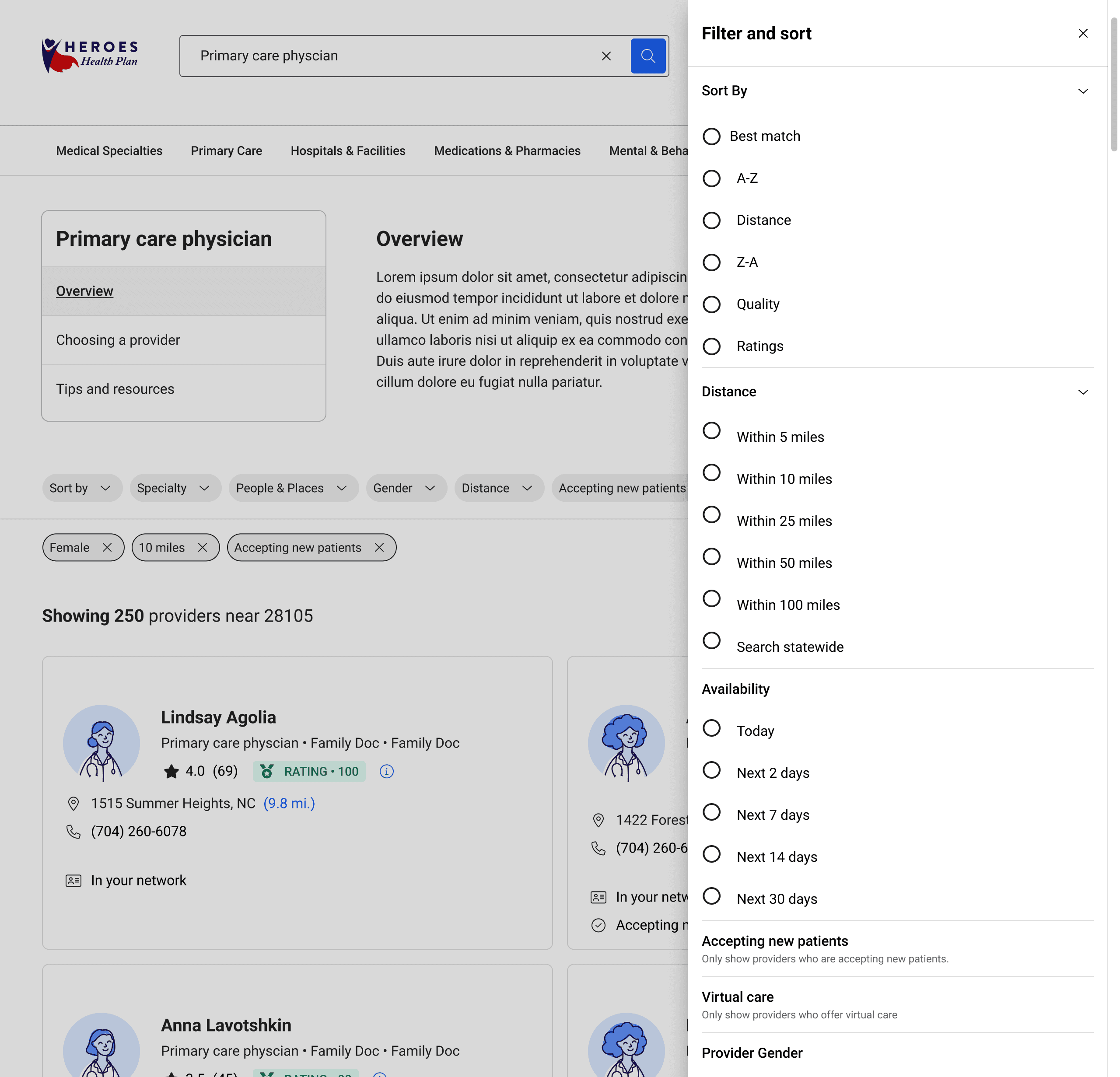
North star designs

North star designs

While our North star concepts raised awareness, they alone didn’t drive action. Real progress came from combining these concepts with metrics like CSAT and member feedback from the MX Index, an internal measurement tool, along with client data analysis and feedback, and comprehensive user research. This approach demonstrated the impact of UX/UI improvements on user satisfaction and business performance, securing stakeholder buy-in.

Discovery and research

The high volume of member complaints and low engagement reveal key barriers in faceted navigation.

01/ High volume of member complaints

Of the 1,600 sources of member feedback analyzed in Q1'24, faceted navigation was the top UX/UI issue for members. Representing % of responses.

Top 15 UX/UI issues according to members

Filter/Sort

Filter/Sort

Navigation

Navigation

Network

Visibility

Network

Visibility

Search Bar

Search Bar

Change Location

Change Location

Map

Map

Outdated data

Outdated data

Appointment

Booking

Appointment

Booking

Change Network

Change Network

Missing Info

Missing Info

Browse Tiles

Browse Tiles

Site Load

Site Load

Auto-Suggest

Auto-Suggest

Compare

Compare

Login

Login

180

168

142

78

69

63

58

54

49

44

39

33

29

24

19

0

20

40

60

80

100

120

140

160

180

UX/UI Issues

UX/UI / Data Issues

UX/UI / Performance Issues

01/ High volume of member complaints

We analyzed 1,600 member feedback responses in Q1 2024. Filters & Sort emerged as the most reported UX/UI issue, significantly outpacing other concerns, highlighting a breakdown in how users refine and control their search experience.

"I am trying to find a specialist in ADHD and Menopause and neither is represented on here....another incident of women's needs being underrepresented"

-

Member 1

"Why can’t I choose more than one specialty at the same time?"

-

Member 2

"I don’t know if my filter was actually applied"

-

Member 3

"How do I clear my filters"

-

Member 4

"I can’t tell why certain providers are showing up in my results"

-

Member 5

“Why can’t I remove just one filter without clearing everything?”

-

Member 6

"I tried several filters but I’m still getting hundreds of results"

-

Member 7

"I had to scroll halfway down the page before I noticed these were filters”

-

Member 8

“I had no idea there were more filters hidden under ‘More filters”

-

Member 9

“Why can’t I click on some of these filters? What is the purpose of showing them if I can’t do anything with them?”

-

Member 10

“Some of these filter names are confusing. I’m not sure what they actually do.”

-

Member 11

“Some of these filter names are confusing. I’m not sure what they actually do.”

-

Member 11

“It is impossible to use filters on my mobile device. I have never seen something so bad.”

-

Member 30

“I selected a filter and suddenly I only had two results. I didn’t expect that.”

-

Member 12

“I wish I knew how many providers each filter would return before selecting it.”

-

Member 13

“I wish I could exclude certain options instead of only selecting one.”

-

Member 14

“Why can’t I filter by things like wait time or appointment availability?”

-

Member 15

“I’m trying to find someone who treats my condition but there’s no filter for it.”

-

Member 16

“I’m looking for a specific doctor but there’s no easy way to jump to their name.”

-

Member 17

“There are too many filter options and no way to quickly find the one I need.”

-

Member 18

“I want to adjust my filter selection as I am scrolling through results. I can’t remember which filter I applied.”

-

Member 19

“The list of specialties is so long it’s hard to find the one I need.”

-

Member 20

“I’m not sure if these filters are narrowing the results or making things worse.”

-

Member 21

“I don’t understand why these results are considered the ‘best match.’”

-

Member 22

“It feels like I have to guess which filters will actually help.”

-

Member 23

“It would help to know how many results I’ll get before I apply a filter.”

-

Member 24

“ I can’t remember how many filters I applied or which filters I applied.”

-

Member 25

“I just want to sort my results by distance, but why can’t I do this?”

-

Member 26

"I don’t understand what some of these filters mean"

-

Member 27

"The site needs options for filtering “ The list has 403 providers. Which ones work with listings - how do I children? Which ones specialize in a decide??" certain area/with certain conditions"

-

Member 29

"I'm looking at a list of Podiatrists in my area. There are 26 pages of them, but no way to sort or narrow the search results, forcing me to look through 26 pages of doctor names to find mine"

-

Member 28

Members have a lot to say….

02/ Low member engagement with filters

Additionally, with our product and research partners we analyzed faceted search data from 30 client representing urban and rural demographics, and found the top filter "Accepting New Patients" accounted for just 14% of usage, twice as much as the next most-used filter "Distance".

Additionally, with our product and research partners we analyzed faceted search data from 30 client representing urban and rural demographics, and found the top filter "Accepting New Patients" accounted for just 14% of usage, twice as much as the next most-used filter "Distance".

Client filter usage distrubution

ANP

Distance

Specialty

PCP

People & Places

Other

03/ User testing insights aligns with metrics from MX Index/heuristic violations?

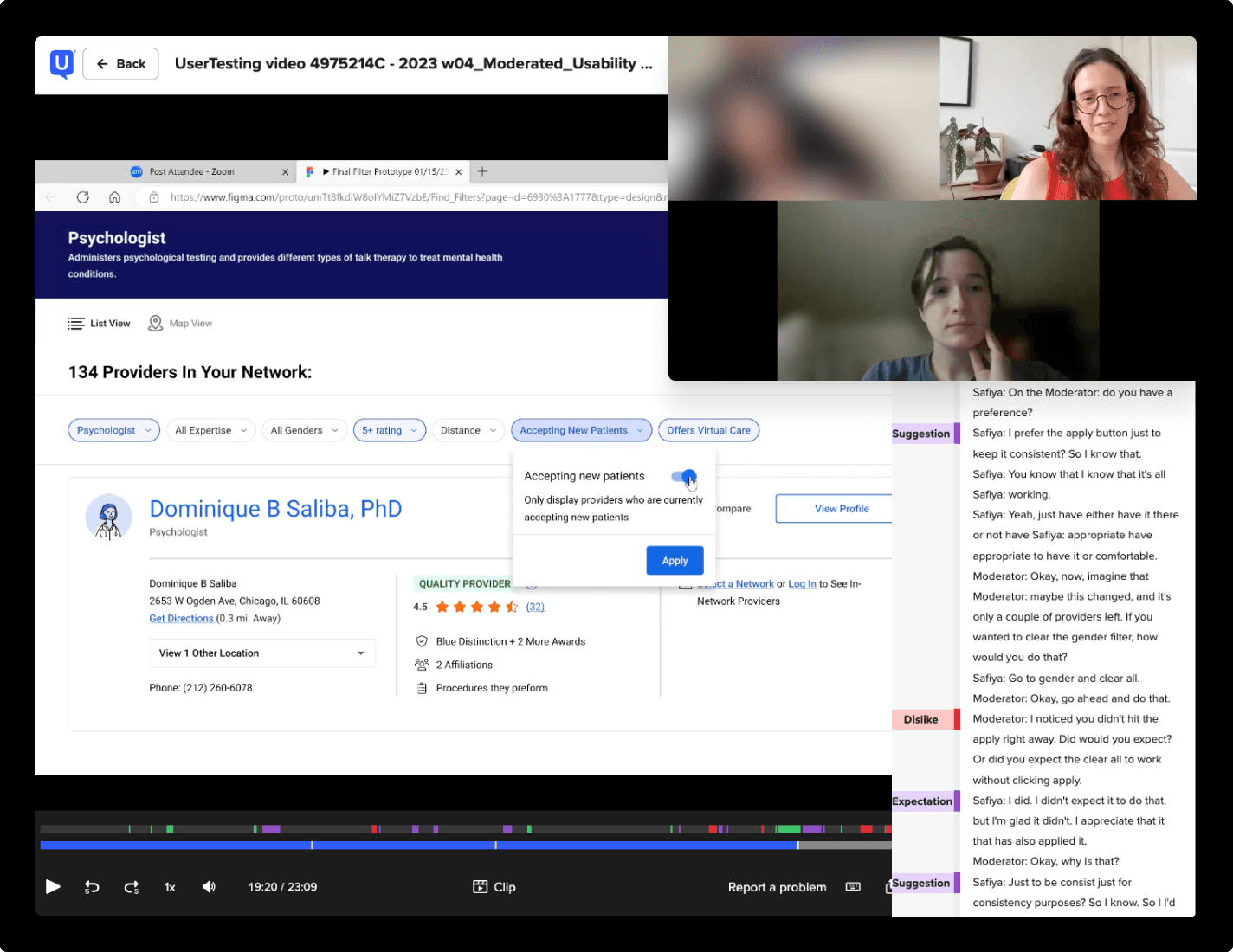
Usability testing of the existing faceted navigation confirmed that users found the filters confusing and irrelevant, often leading them to overlook filters altogether.The disconnect between user needs and the available filters disrupted their search experience and eroded trust in the tool, affecting their overall healthcare journey.

Lack of consistency & standards

Users struggled with seeing and interacting with the existing filters, creating friction in completing tasks.

CONSISTENCY & STANDARDS

Poor system feedback

Users lacked clarity about how their actions affected search results, eroding trust in their provider-finder tool.

RECOGNITION RATHER THAN RECALL

VISIBILITY OF SYSTEM STATUS

High cognitive load

The complex interface and abundance of irrelevant options overwhelm users, making it difficult to make informed decisions.

RECOGNITION RATHER THAN RECALL

MATCH BETWEEN THE SYSTEM & THE REAL WORLD

Limited functionality

Users couldn’t refine results in ways that reflected real-world needs. 

FLEXIBILITY & EASE OF USE

Lack of consistency & standards

Users struggled with seeing and interacting with the existing filters, creating friction in completing tasks.

CONSISTENCY & STANDARDS

Poor system feedback

Users lacked clarity about how their actions affected search results, eroding trust in their provider-finder tool.

RECOGNITION RATHER THAN RECALL

VISIBILITY OF SYSTEM STATUS

High cognitive load

The complex interface and abundance of irrelevant options overwhelm users, making it difficult to make informed decisions.

RECOGNITION RATHER THAN RECALL

MATCH BETWEEN THE SYSTEM & THE REAL WORLD

Limited functionality

Users couldn’t refine results in ways that reflected real-world needs. 

FLEXIBILITY & EASE OF USE

From research to design iterations

Turning insights into outcomes

To effectively address the challenges captured during the research phase, we adopted Teresa Torres’s Opportunity Solution Tree (OST), an insights aggregator. This framework enabled us to prioritize solutions based on user and client insights, facilitating a shift from a sales-led output-driven mindset to an outcome-focused approach centered on user needs.

From this framework, we identified three core breakdowns in the experience: discoverability, comprehension, and trust. These became the foundation for our design priorities and guided an iterative testing and design phase:

Improve discoverability of filters so users can easily access ways to refine their search

Clarify how filters work to reduce ambiguity and support confident decision-making

Increase transparency in how results are generated to rebuild trust in the system

These priorities directly informed the redesign of faceted navigation as a cohesive, system-level experience. The goal was to move from a fragmented set of controls to a structured framework that supports how users iteratively search, refine, and evaluate care options.
The outcome

Reframing faceted navigation around real search behavior

Building on these priorities I led the redesign of faceted navigation into a system that better aligns with how members actually search: iteratively, across multiple criteria, and requiring clear feedback at every step.

The solution balances these user behaviors within a highly configurable B2B2B2C environment, establishing a more intuitive and flexible filtering framework that improves usability while supporting diverse client needs.

01/ Improve filter discoverability through familiar interaction patterns.

Reorganized faceted navigation with chip-based filters and a consolidated horizontal filter bar, increasing visibility, clarifying the hierarchy, and increasing engagement with filtering.
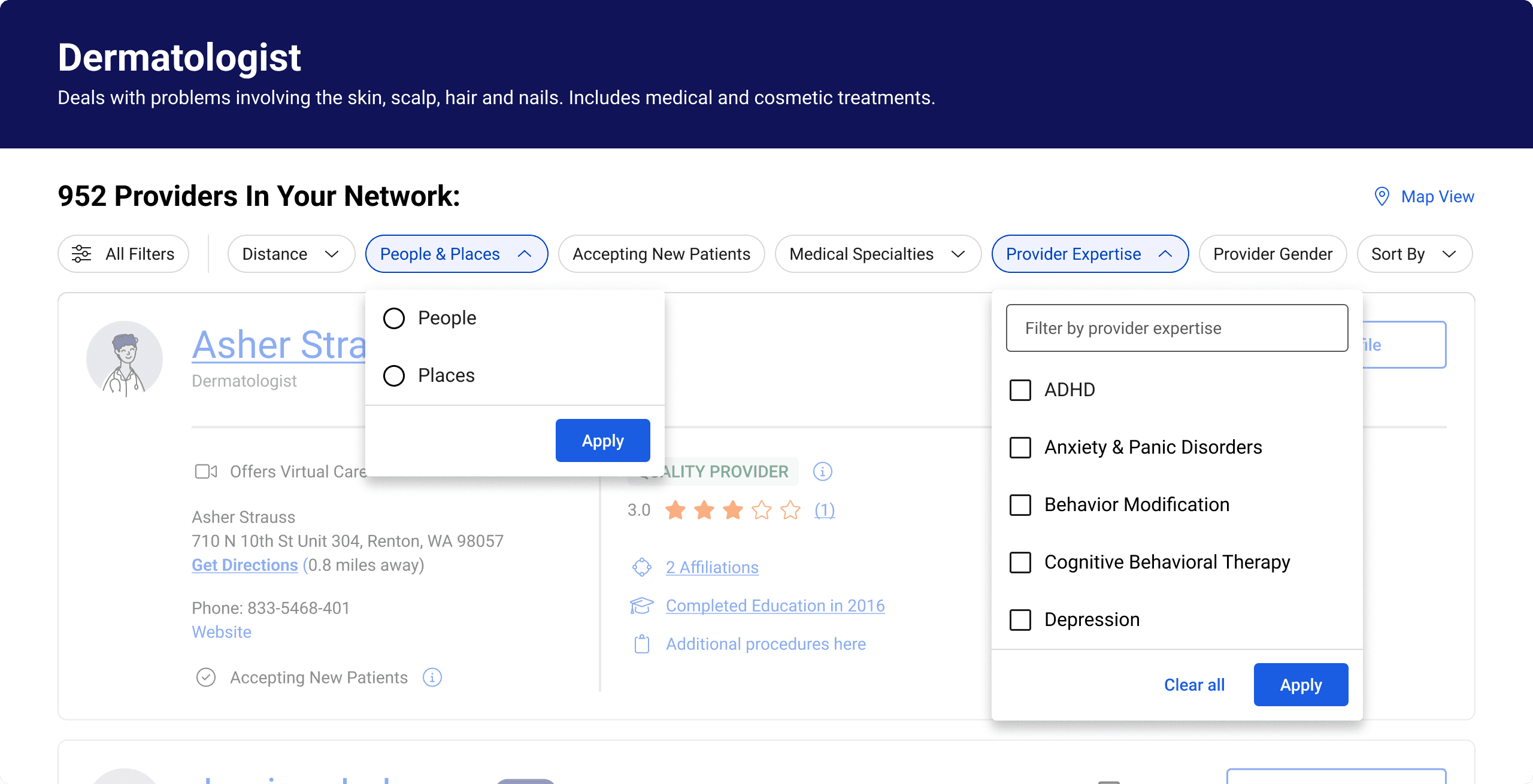
02/ Enable flexible, multi-criteria refinement aligned with real search behavior

Introduced multi-select interactions with “AND/OR” logic, allowing users to combine filters more naturally and generate more accurate, relevant results.

03/ Reduced cognitive load through structured organization.

Standardized naming conventions, grouped filters into a single dialog, and introduced inline filtering for long attribute lists to simplify navigation in a complex healthcare context.

04/ Build user confidence through clear feedback and system transparency.

Designed clear confirmation and feedback states to increase users’ sense of control and trust in how results are filtered, while also supporting compliance with WCAG AA accessibility standards.

The result

The redesign impact

Faceted navigation is no longer the primary UX/Ui concern with filter-related complaints decreasing, highlighting a reduction in friction and frustration. At the same time, filter adoption has increased despite stable traffic, signaling a shift in user behavior rather than volume.

33%

33%

33%

reduction in member filter-related complaints.

6

th

UX/UI complaint, down from number 1 complaint.

+

9.3

increase in filter adoption from 18.4% to 27.7%, while traffic remained stable.

From design to build

Translating design into scalable implementation

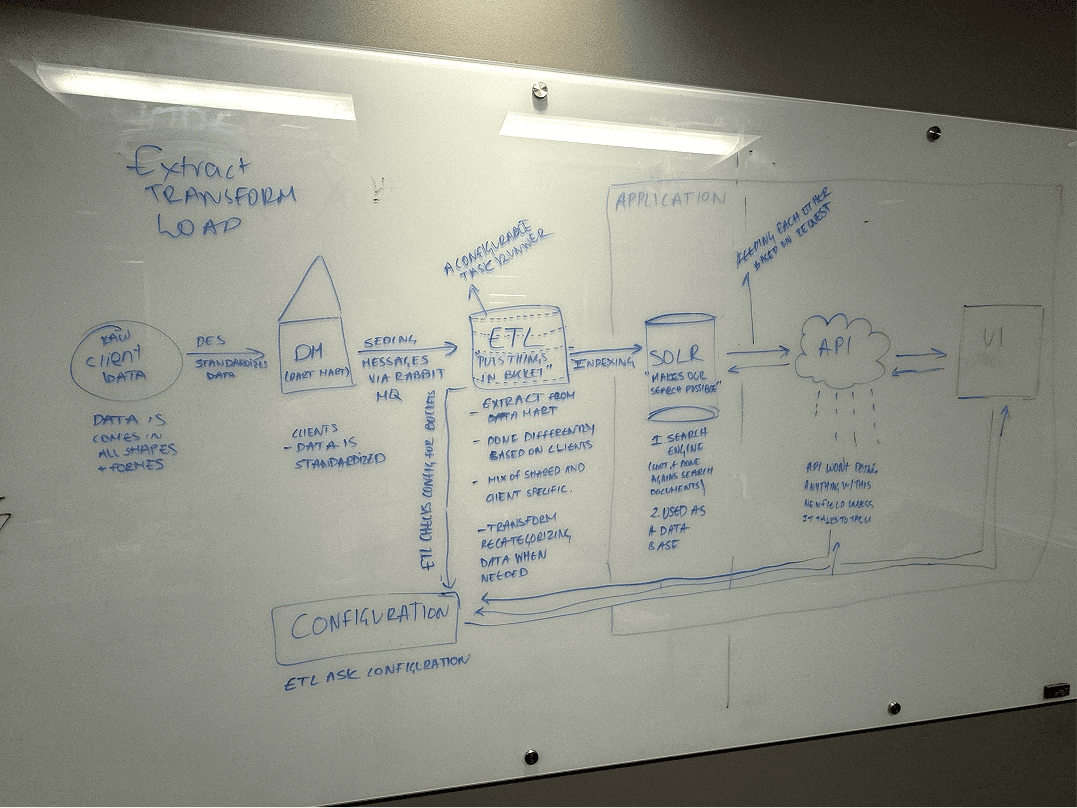
Implementing the redesigned filtering experience required navigating legacy architecture, fragmented data sources, and highly configurable client requirements. To align design, product, and engineering, my product partner and I organized a two-day Filter Evolution Summit that brought together engineers, QA, and configuration teams.

Together, we structured these sessions to surface system constraints, and technical dependencies, and align on a shared path forward, shifting the team from reacting to isolated implementation challenges to aligning around a cohesive system.
Leveraging the design language system

The Design System served as the foundation for building reusable and scalable UI patterns. Existing components enabled rapid assembly of key filtering interactions, including the horizontal filter bar, accelerating development and reinforcing consistency across the experience.

At the same time, the implementation highlighted the limitations of a system that had not evolved at the same pace as product needs, largely due to competing business priorities. Gaps in component structure and flexibility were exposed, requiring additional development and slowing the delivery of the faceted navigation experience at scale.

Reflections

01 /

Aligning early with technical partners to reduce downstream friction

Delivering a system-level redesign within a legacy architecture reinforced the importance of engaging technical partners early. Aligning on constraints and dependencies upfront enables more proactive decision-making and reduces integration challenges during implementation.

01 /

Aligning early with technical partners to reduce downstream friction

Delivering a system-level redesign within a legacy architecture reinforced the importance of engaging technical partners early. Aligning on constraints and dependencies upfront enables more proactive decision-making and reduces integration challenges during implementation.

02 /

Defining guardrails in a highly configurable B2B2B2C system

02 /

Defining guardrails in a highly configurable B2B2B2C system

Sandrine Daly

Product designer based in New York, shaping systems that help people make decisions by clarifying what matters.

Sandrine Daly

Product designer based in New York, shaping systems that help people make decisions by clarifying what matters.

Sandrine Daly

Product designer based in New York, shaping systems that help people make decisions by clarifying what matters.